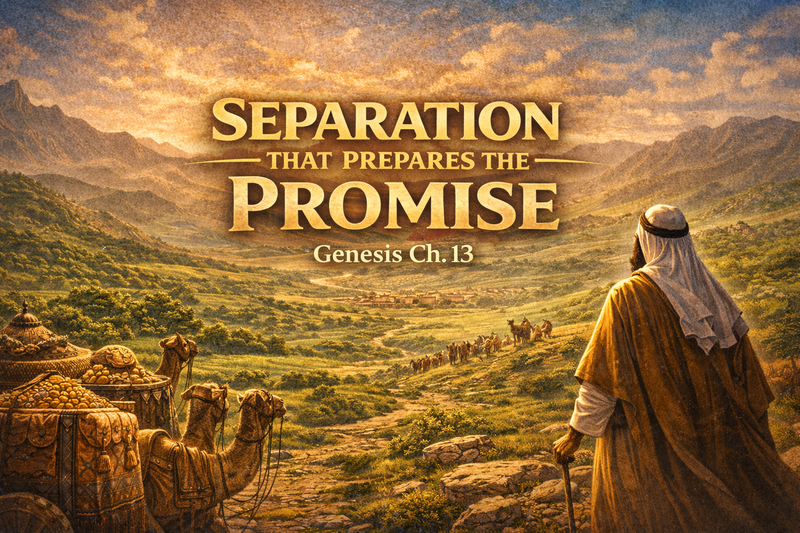
Abram’s journey reveals what faith looks like after the initial call. After detouring to Egypt in fear, he returns not to something new, but back to the altar—the place of worship and dependence. Though materially richer, he recognizes that provision was never the issue; trust was. True restoration comes through returning to first things: living as a pilgrim in the tent and a worshiper at the altar. When conflict arises with Lot, Abram chooses peace over position and generosity over grasping, demonstrating that confidence in God’s promise frees a person from self-protection. In contrast, Lot walks by sight, choosing visible prosperity near Sodom, exposing a heart governed by self-interest rather than submission to God.
Once the separation occurs, God speaks again, reaffirming and enlarging His promise. Abram is invited to lift his eyes, not to choose for himself, but to see what God will give. Though childless and landless in practical terms, he is promised descendants as numerous as the dust and a territory that stretches in every direction. Abram responds not with strategy, but with obedience and worship—walking the land in faith and building another altar. The chapter ultimately contrasts two paths: one driven by visible advantage that leads toward loss, and one marked by trust, humility, and worship that secures lasting promise. Faith releases its grip on immediate gain because it rests confidently in the certainty of God’s word.